Marine carbon removal · physics of CO2 in water · draft for review · July 2026
We measured where ocean carbon removal actually goes.
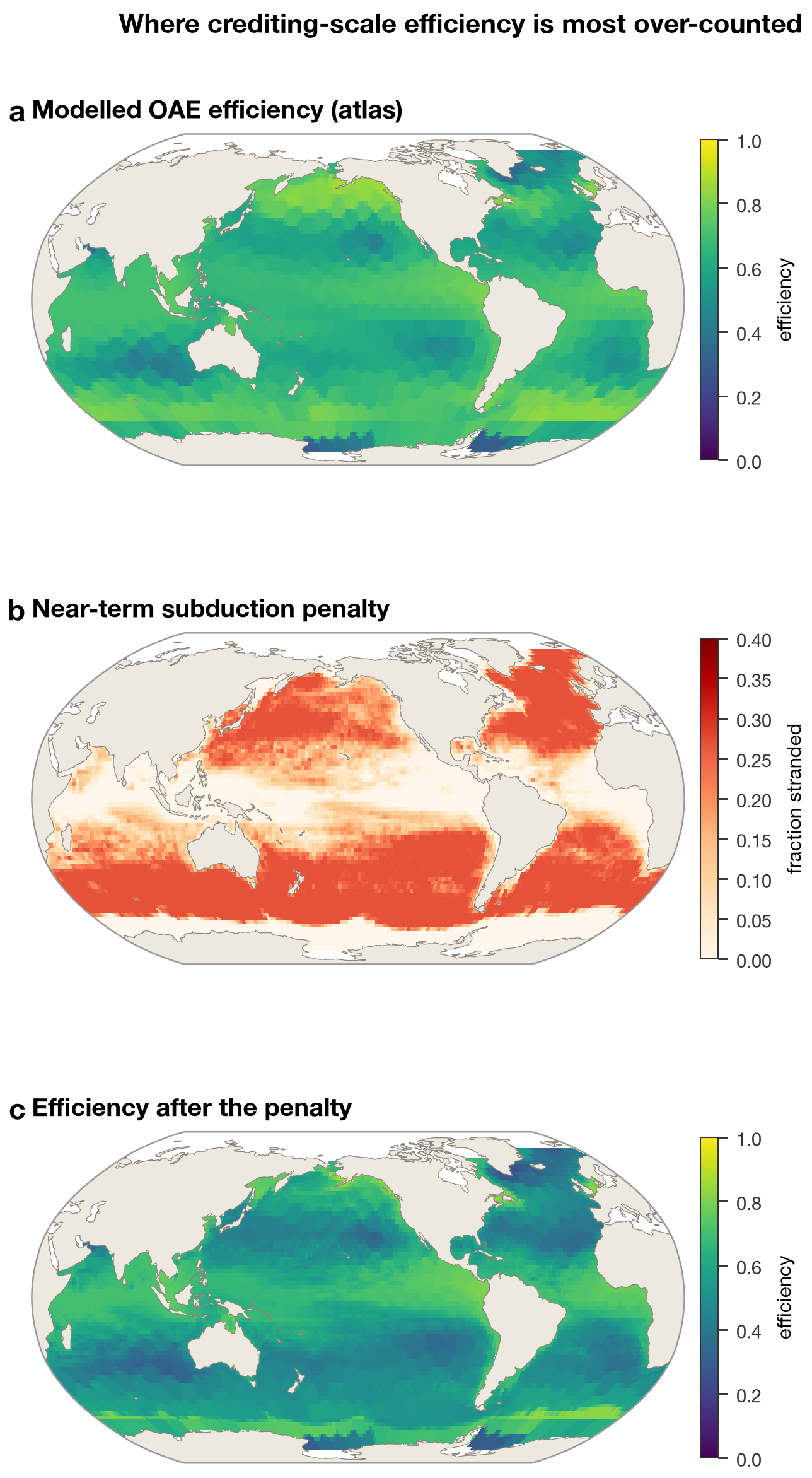
Ocean alkalinity enhancement is credited on model estimates of how much added alkalinity becomes atmospheric CO2 uptake. Those models run too coarse to resolve the ocean fronts, a few kilometres wide, where surface water is pulled downward before it can trade its carbon with the air. We measured that missing process in two independent high-resolution ocean models. At open-ocean fronts, 16 to 38 percent of the treated water is subducted below the winter mixed layer first. Coarsen the models to the resolution used for crediting, and that number drops to about zero. The carbon is not lost. It re-emerges over decades, outside the horizon it was sold on.
Draft, for review. Everything below is work in progress, shared for comment by Mike and colleagues. The documents are open for inline comments. The media and policy pieces are written to be held until the preprint and co-authors are in place, and are shown here as drafts, not as released material.
[01] The mechanism
Equilibrate before you subduct.
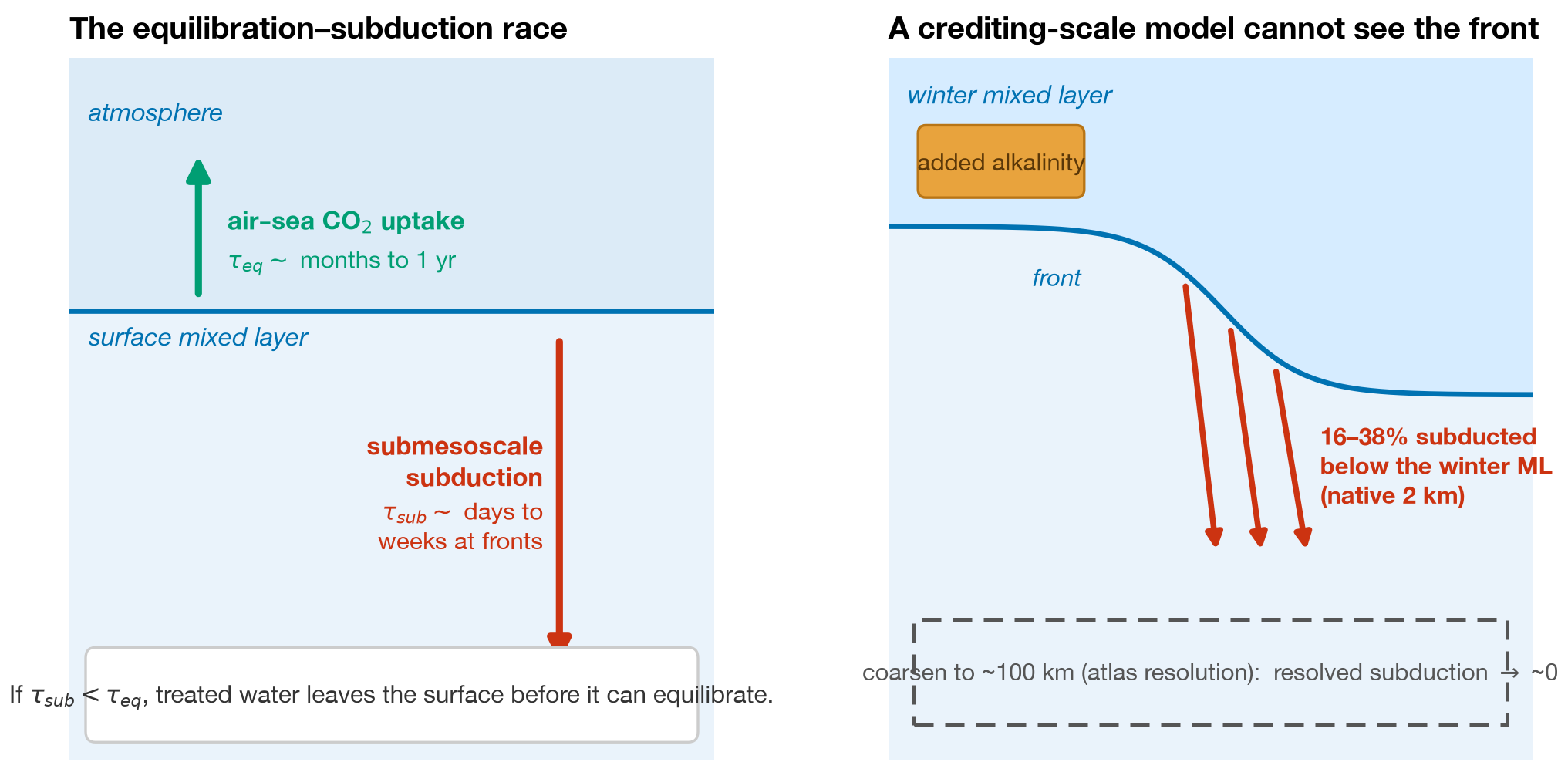
Added alkalinity draws down atmospheric CO2 only while the treated water stays in contact with the air, over an equilibration time of months to a year. At an ocean front, submesoscale motions can pull that water below the mixed layer in days to weeks. When the water leaves the surface first, the uptake it was credited for is deferred to the deep-ventilation timescale. The fronts that do this are a few kilometres wide, and the models used to credit run near 100 kilometres, so they cannot see it.
[02] The measurement
Fourteen regions, one number that holds.
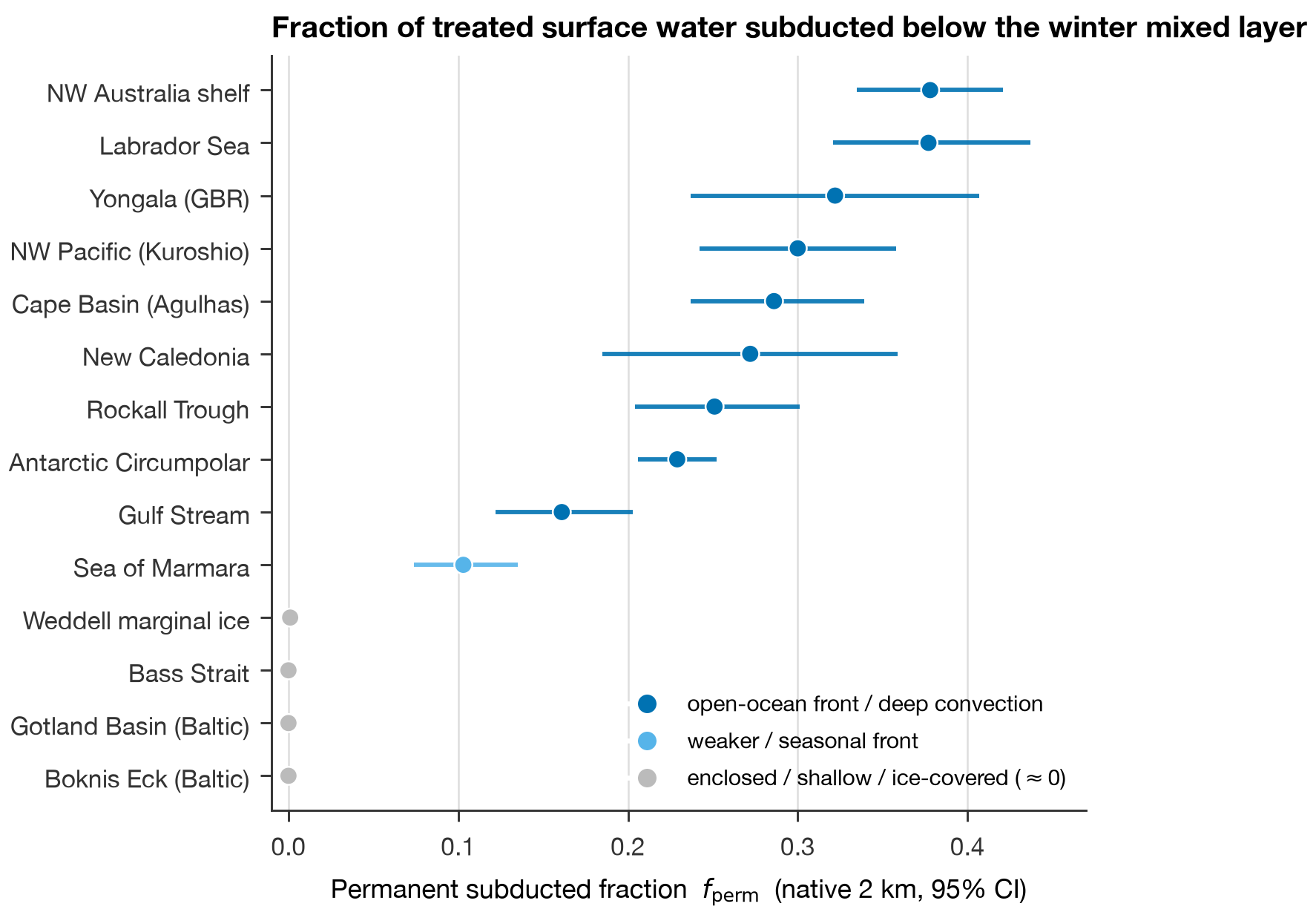
We seeded passive tracer in the mixed layer of a 2 km ocean model and tracked, region by region, the fraction subducted below the winter mixed layer faster than the water could equilibrate. Open-ocean fronts and deep-convection sites strand 16 to 38 percent. Enclosed, shallow, and ice-covered basins strand close to nothing. This is a measurement of passive-tracer transport, from which we infer the efficiency penalty through the timescale race. We did not simulate the carbonate budget inside the high-resolution model, and we say so plainly.
[03] The decisive test
Coarsen the model and the signal disappears.
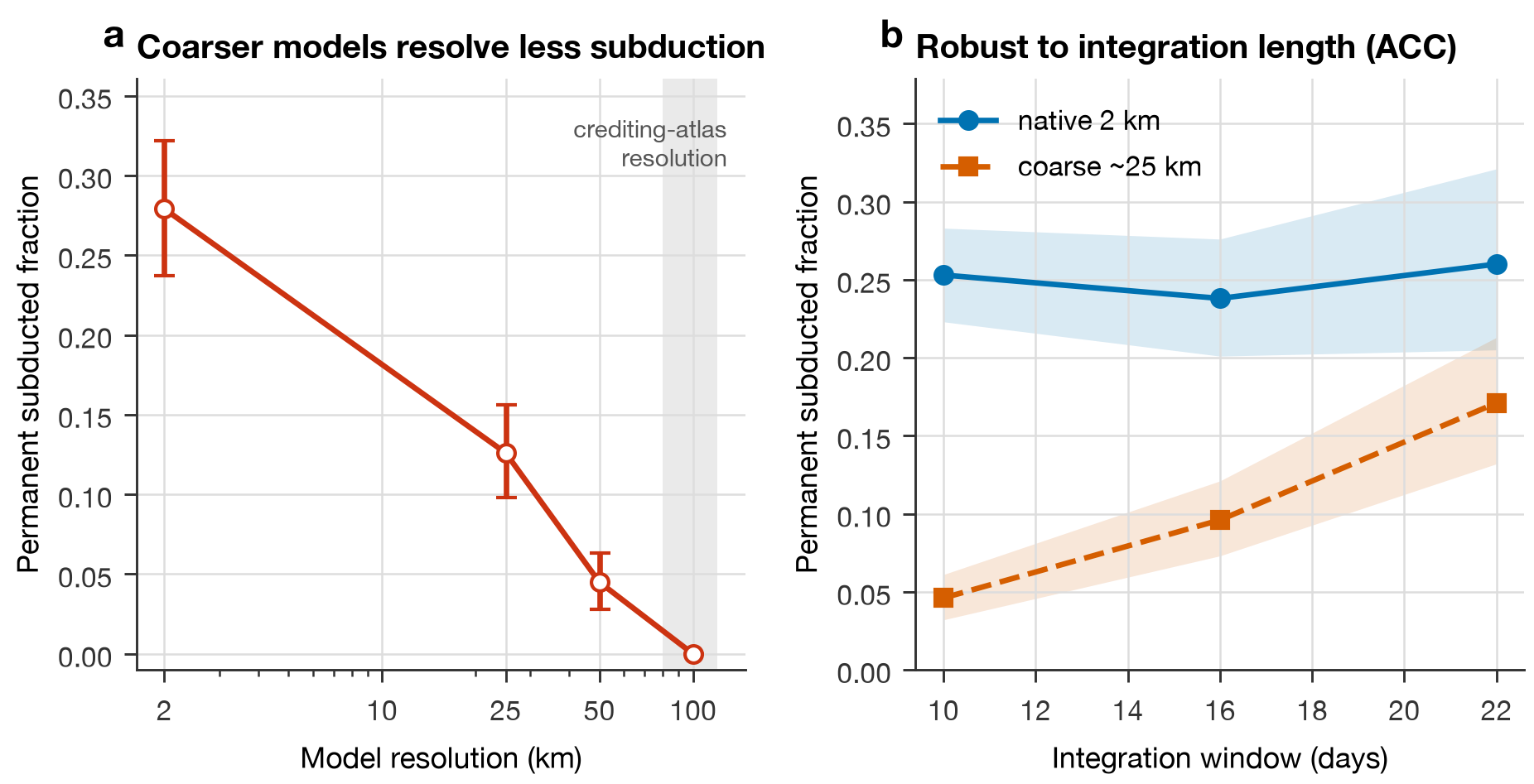
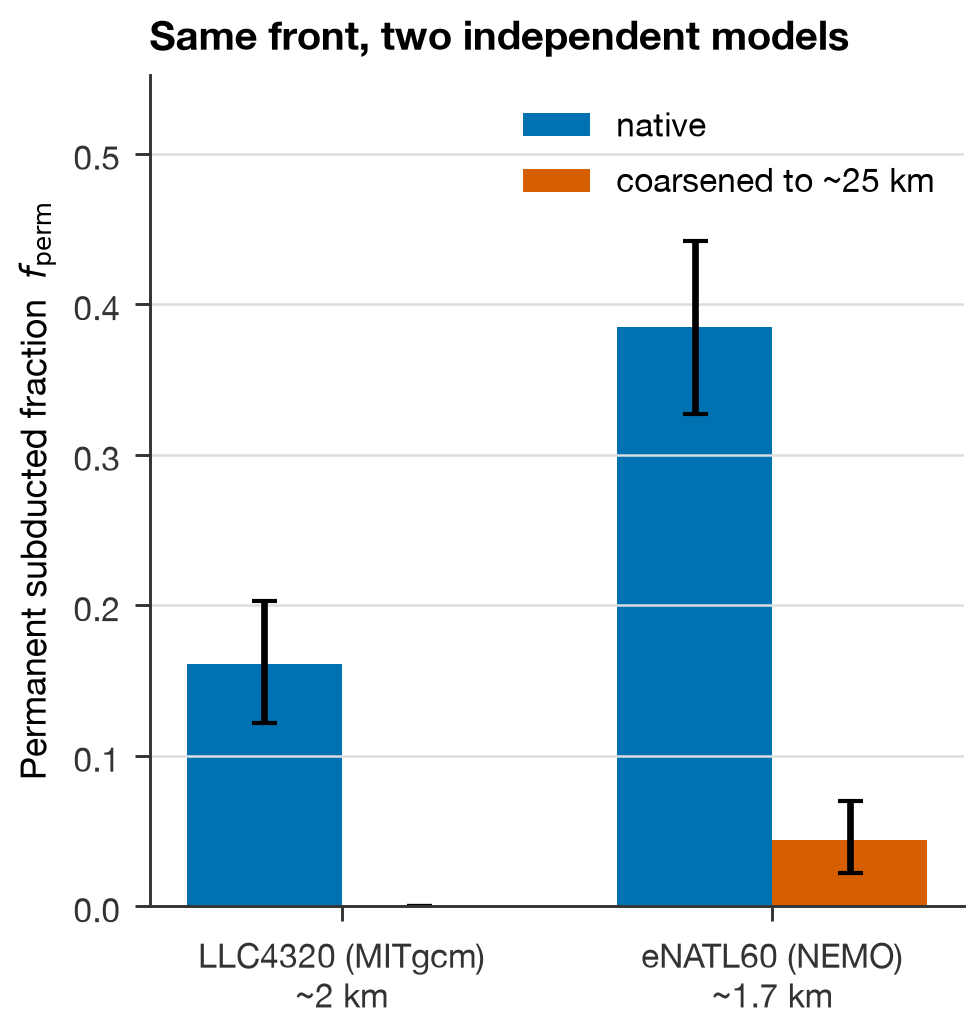
The claim is that crediting-scale models cannot see this. So we coarsened our own model and watched the subducted fraction collapse toward zero at the atlas resolution. It is robust to how long we integrate, and it is not an artifact of one model. The same Gulf Stream front, measured independently in a NEMO model built on different numerics, reproduces a material native fraction that the coarse field does not resolve.
[04] Where it matters
The over-count is concentrated, and it is on the good real estate.
Applied globally as a regime model, the near-term over-count concentrates in the subpolar North Atlantic and Pacific, the Nordic Seas, and the Southern Ocean, the same deep-mixing waters where alkalinity is most often proposed to be added. It is of order 10 to 20 percent across the atlas ocean, and larger in those regions. We treat it as a resolution-bounded regime estimate, not a calibrated correction.
[05] The sign depends on the method
A penalty for chemistry, an aid for biology.
This physics cuts both ways, and a framework that spans marine CDR has to say so. For methods that rely on air-sea gas exchange, alkalinity enhancement and direct ocean capture, subduction is a near-term penalty. For biological methods that fix carbon at the surface and rely on its export to depth, iron and nutrient fertilization, macroalgae cultivation and sinking, artificial upwelling, the same subduction can aid removal, with permanence set by export depth rather than air-sea exchange. The question for any project is which physical control governs it, and whether the developer can measure the result.
[06] The portfolio
Everything, in draft, open for comment.
The full set of deliverables, organized by audience. Each opens as a Google Doc with inline commenting on. They are drafts open for comment, not submitted, final, or released. The single source folder is here.
Science
4 docsThe peer-review track: the primary measurement paper, the open data and code, and a withdrawn synthesis kept for the record.
Paper A — the measurement
Submesoscale subduction biases OAE efficiency atlases at ocean fronts. Manuscript draft.
Open & comment →
Paper B — the synthesis (withdrawn 7 Aug 2026)
Withdrawn before submission. Its premise, that in-situ DIC stripping is credited as though it escapes the air-sea filter, was false. Isometric's Direct Ocean Capture protocol already requires equilibration to be quantified before crediting. Kept for the record.
Open & comment →
Figure set
The five publication figures, captions, and production status.
Open & comment →
Data & code release
Zenodo README: derived data, analysis pipeline, and external-data provenance.
Open & comment →
Policy
3 docsThe case for measurement-based crediting, sized for agencies, registries, and congressional staff.
Policy white paper
Why ocean-CDR crediting should be measurement-based, and what to change.
Open & comment →
Policymaker 2-pager + deck
One-idea-per-slide brief for NOAA, DOE, EU DG-CLIMA, and staff.
Open & comment →
Registry / MRV submission (withdrawn 7 Aug 2026)
Withdrawn before submission, same reason as Paper B. The registry protocol already requires what it recommended. Kept for the record.
Open & comment →
Investment
1 docWhere the binding constraint is verification, and what that means for capital.
Communication
2 docsPlain-language derivatives, held until the preprint anchors them.
Planning & review
2 docsHow the portfolio fits together, and the adversarial pass over it.
Related work & sites
The investability site, the tools, and the wider research.
The physics here feeds an investment view, and it sits inside a broader Steps research program. The links below go to the investability write-up and screener, the open data and code, and the other work we have researched and put in public.
Interactive world map
Efficiency, verifiable-realization potential, and national EEZ layers over the ocean, with every real deployment. Filter, search a coastline, click for a local readout.
Open →
Investor draft — the thesis
The binding constraint is verification. Method-by-method and geography-by-geography performance, open for comment.
Open →
Paper A — the measurement
The full manuscript draft with all five figures.
Open →
Investability screener (interactive)
Pick a method and a site, get the physics breakeven and realized-fraction bands.
Open →
Live investability paper
The comprehensive write-up: efficiency atlas overlay, national guidance, and the investor playbook.
Open →
Data & code
The analysis pipeline and derived data, openly released.
Open →
Steps research program
Computing signal out of public data: ecology, history, reproducibility, and more.
Open →
SorbentBase
An open database of water-treatment sorbent performance, 26,000+ measurements.
Open →
The research notebook
The full timeline of what we tested, what held, and the honest nulls.
Open →
Honest note
What this is, and what it is not.
This is an argument for measuring ocean carbon removal, not against it. The finding is about methods that rely on air-sea gas exchange. It rests on passive-tracer transport measured in two high-resolution models, with the efficiency penalty inferred through the equilibration timescale, and the confidence intervals are a within-model lower bound rather than the full uncertainty. The global figure is a resolution-bounded regime estimate. The work has not been submitted anywhere. It is open for comment and seeking co-authors before submission, and the policy, investment, and media pieces are held until the science anchors them.
Steps Ventures is an advisory firm. This portfolio is grounded in unpublished research, released openly for comment.