Open research notebook · updated June 2026
The Eel Project
Where do eels spawn, and what is climate doing to the spawning ground? This is a working notebook: the question, the datasets, the tests we ran, what held up, and what did not. Leading thoughts at the top. The full progression below.
Where it stands now
Current leading thoughts
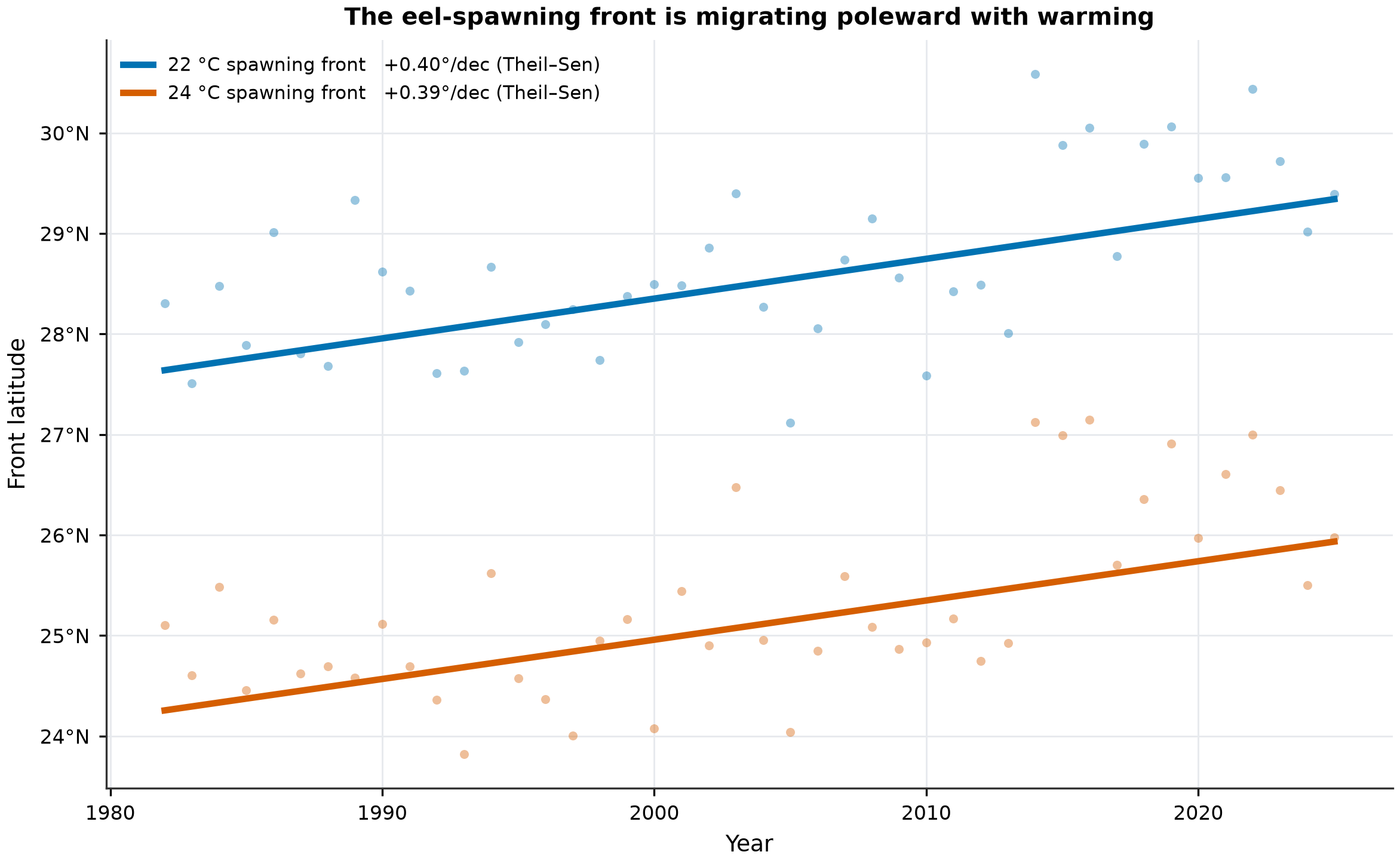
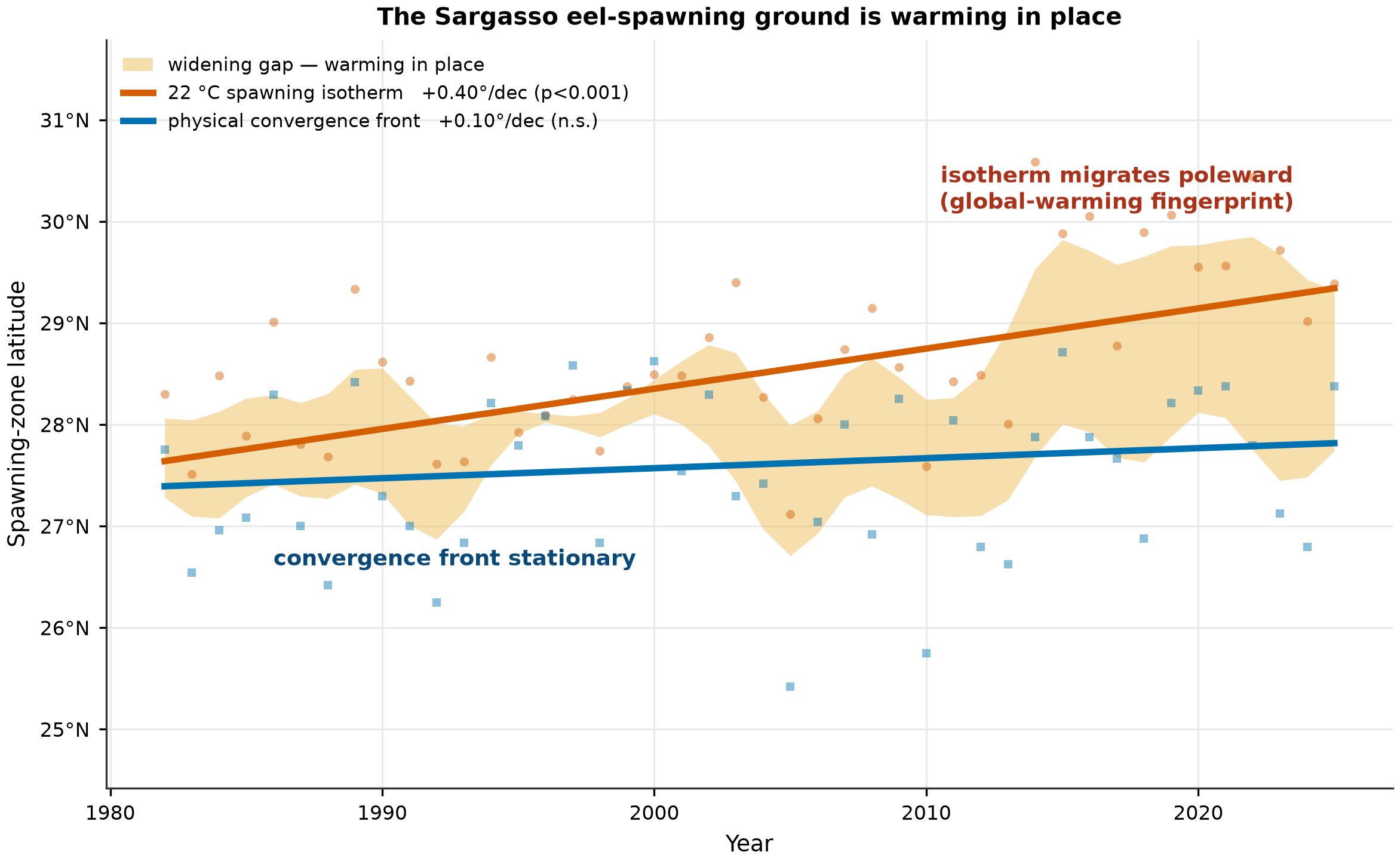
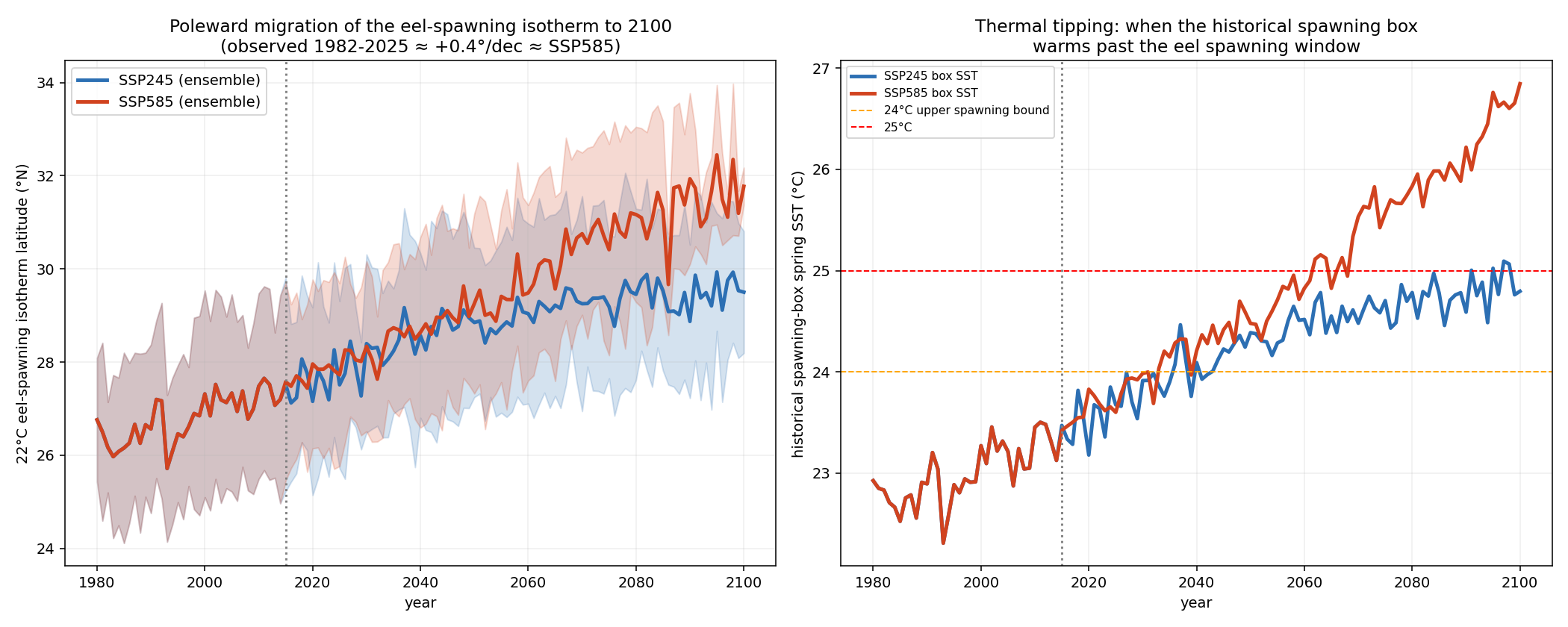
1. The strongest, most defensible result is about the eel itself. The 22-24°C spawning isotherms are sliding ~190 km poleward, faster than the slower-moving SST-gradient front that bounds the spawning zone (a geometric consequence of near-uniform warming, not a stationary front). The ground is “warming in place,” already at the upper thermal bound of spawning, and the historical decline is decoupled from larval transport. This reframes the dominant front-displacement narrative and is, in our view, the publishable standalone contribution.
2. The cross-species generalization is a hypothesis, not a law. The anchoring framework organizes known climate-reproduction cases well, but failed an independent test on real-world fish recruitment. We report that null openly. It is the honest state of the evidence and the kind of result that rarely gets published.
3. A reusable open-data asset exists regardless. A harmonized 14k-species database and an autonomous ingestion pipeline, useful for trait-based climate-vulnerability work well beyond this project.
Progression of ideas
How the question evolved
Start
The question: where do eels spawn, and is climate moving it?
The European eel spawns only in the Sargasso Sea, and no egg has ever been observed in the wild. It has collapsed >90%. The standard story: warming displaced the spawning front and broke the larval route to Europe. We set out to test that with the satellite + in-situ record, an eddy-resolving larval-transport model, and a CMIP6 ensemble.
Result 1
The spawning ground is "warming in place"
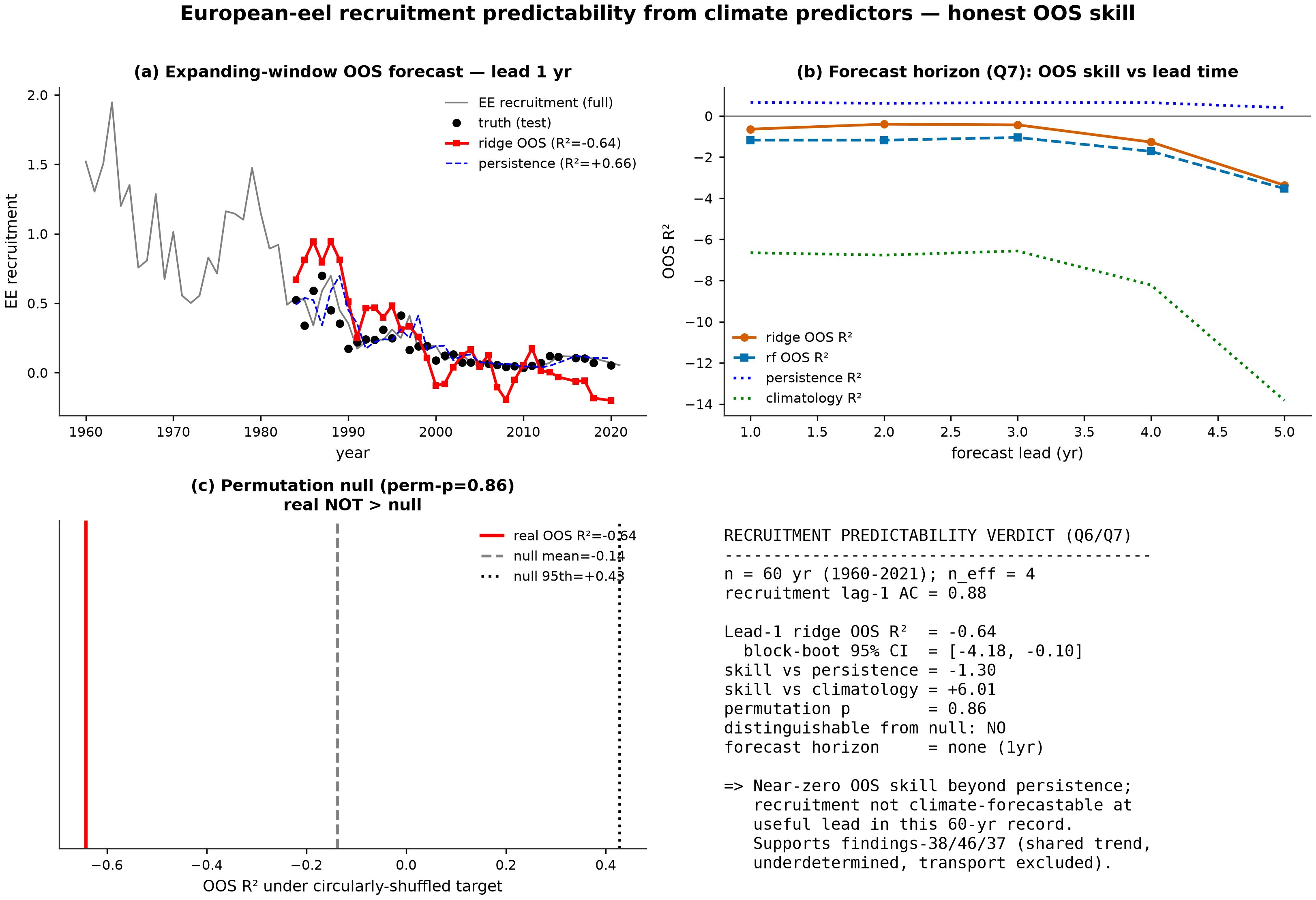
The 22-24 C spawning isotherms migrated poleward ~0.4 deg/decade (~190 km), robust across two SST products, attributable to global warming. The physical convergence front migrates much more slowly (<=0.13 deg/dec, validated against Argo + cruise data). The isotherms outrun the slower front, a geometric consequence of near-uniform warming (we do not claim a stationary front). Larval delivery is swim-controlled and front-insensitive, and recruitment is unforecastable from spawning climate. So the collapse is not transport/displacement-driven, and the ground already sits at the upper thermal bound, warming +1.7 to +3.3 C by 2100: warming overtaking the spawning zone in place rather than a target the eel can follow.
Generalization
The "anchoring" idea, from one eel to many species
The eel pattern suggested a general one: reproduction is tethered to a moving reference (a thermal isotherm, a breeding date, a substrate). The anchor sets the failure mode, an "escape capacity" sets the severity. We built it into a framework and blind-tested it across 101 species over 13 pre-registered rounds.
Looked strong
Blind tests: ~88% hit, but a catch
On held-out species the framework scored ~88% with the correct winner/loser side every time, and an escape axis that predicted our own coded severity at AUC ~0.95. We hardened it against the standard objections (circularity, phylogeny, realized-vs-projected). But when we tried to assign the key parameter blind to the species, the skill dropped to ~baseline, a sign the strong number was partly hindsight.
Independent test
The generalization did not survive independent data
We parameterized the model from measured databases (Dahlke thermal limits, NOAA ERSST warming trajectories) and tested it against a fully independent reproductive outcome, fish recruitment from the RAM Legacy Stock Assessment Database (240 species). At full statistical power the predicted warming->recruitment signal was null (Spearman +0.01, p=0.86, recruits-per-spawner -0.09, p=0.18). An encouraging small-sample hint (-0.22, n=54) did not replicate. Honest verdict: the framework organizes known cases, but does not yet demonstrably predict independent real-world outcomes.
Asset
A reusable open-data instrument fell out of it
The validation effort produced a harmonized 14,000-species table (reproductive thermal limits, thermal tolerance, range-shift outcomes, life-history traits) from six public databases, GBIF-resolved, with a fully autonomous ingestion pipeline. That asset stands on its own, independent of the model.
Result · the standalone contribution
The spawning ground is warming in place
A slow-moving convergence front, faster poleward isotherm migration, and a transport-decoupled recruitment decline (1982-2025). The widely-invoked hypothesis (that climate displaced the spawning front and lengthened or broke the larval route) is largely wrong, and we replace it with a sharper picture.
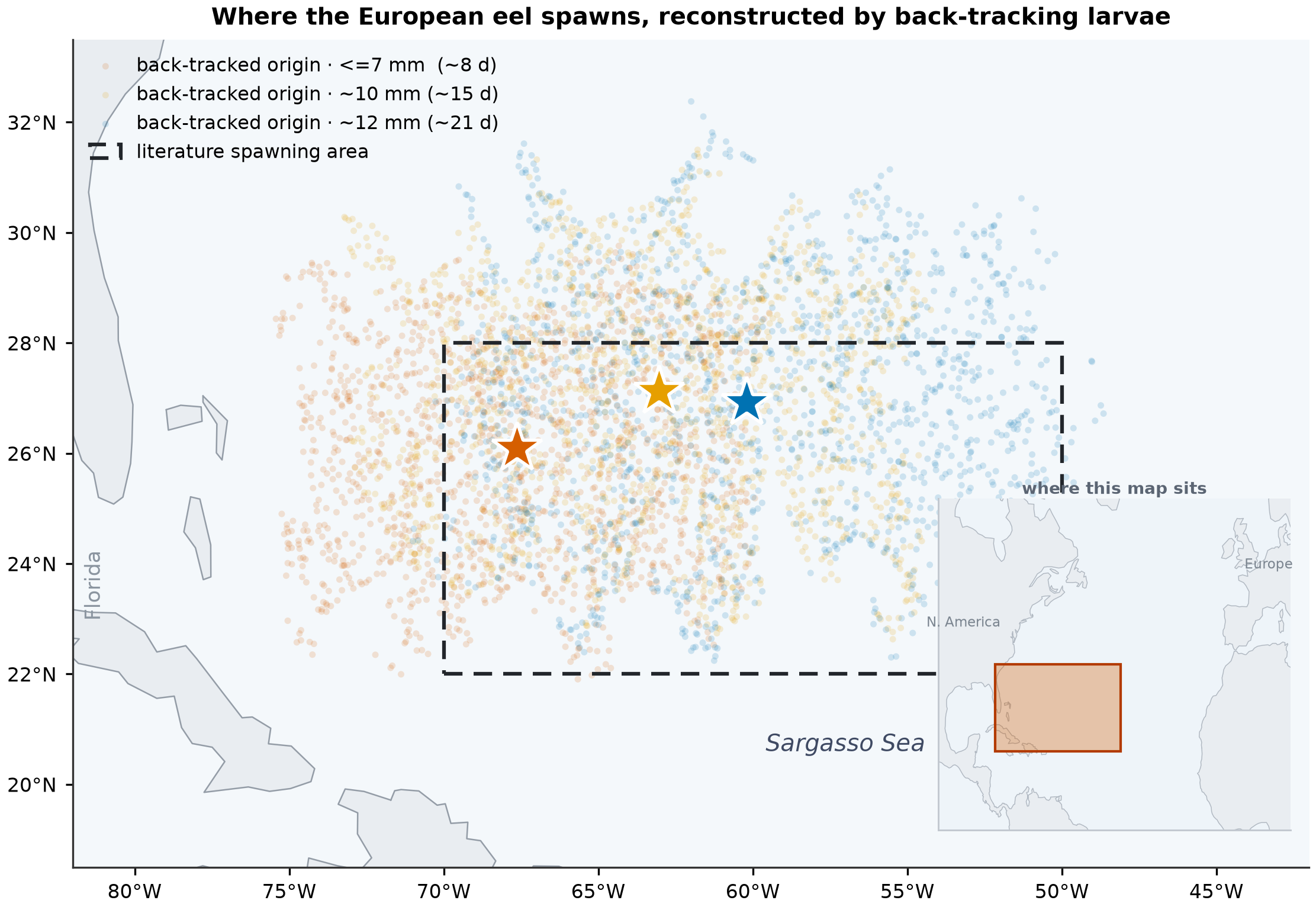
And the original question: where, exactly?
The supporting toolkit includes a differentiable, eddy-resolving Lagrangian larval-transport model and a Monte-Carlo spawn-origin back-tracking inversion, validated against the Atlantic eel leptocephalus database re-examined in Miller et al. (2015, Biological Reviews 90:1035–1064), provided by M. J. Miller as a personal communication. It localizes the spawning region from larval distributions and tests the navigation hypotheses (including a quantum radical-pair magnetocompass) that get a larva from the Sargasso to Europe.
Result · the generalization we tested hard
An idea that looked strong, then didn’t survive independent data
The eel pattern (reproduction tethered to a moving thermal reference) suggested a general framework. We blind-tested it across 101 species in 13 pre-registered rounds. It scored ~88% with the correct winner/loser side every time. We then tried to break it, and largely did.
The honest internal checks
When we hid the species identity and re-derived the model’s key “escape capacity” parameter from traits alone (and even from richer physiology, and from anchor-specific sub-models), the predictive skill collapsed from AUC ~0.95 to roughly the level of a dumb baseline. The strong score lived in the human judgment of the parameter, which we could not show was independent of already knowing each species’ fate. That is the residual-circularity problem, found by us, not a reviewer.
The independent test, and the null
We then built the model from measured databases and tested it against a fully independent reproductive outcome: fish recruitment (RAM Legacy, 240 species), with local warming trajectories from NOAA ERSST. A small-sample hint (Spearman -0.22, n=54, correct sign) did not replicate: at full power the warming-to-recruitment signal was null (+0.01, p=0.86), and the principled per-capita metric (recruits-per-spawner) gave only a weak, non-significant -0.09. Fish recruitment is dominated by fishing, regime shifts, and noise. Any climate-reproduction signal is, at most, faint.
Verdict: the anchoring framework is a useful organizing hypothesis that fits known, literature-documented cases, but it does not yet demonstrably predict independent real-world reproductive outcomes. We are not claiming a predictive law.
On sharing what didn’t work
Why the null is part of the contribution
Negative and null results are systematically under-published, which distorts the literature and wastes other researchers’ effort re-running dead ends. We document the full arc (the pre-registered tests, the methodological fixes, the small-sample reversal, and the independent null) precisely because this is rarely done. The pre-registrations, code, and per-test statistics are all open.
Open-data asset
A harmonized climate-reproduction database
Built to parameterize the model, useful far beyond it: a single per-species table joining reproductive thermal limits (Dahlke et al. 2020, ~470 fish), thermal tolerance (GlobTherm, ~1,600 species), range-shift outcomes (BioShifts, ~12,400 species), and life-history traits (AnAge, Amniote DB), 14,146 species total, name-resolved against the GBIF backbone, with ~300 species carrying both a thermal parameter and a climate outcome. An autonomous ingestion pipeline (Dryad / PANGAEA / figshare / NOAA ERDDAP) keeps it extensible.
Research options · next steps
How this could contribute to the wider science
A. Publish the eel-spawning result. The isotherms-outrun-the-front, warming-in-place reframe is robust, validated, and counters a dominant narrative, the clearest standalone contribution. Target: a climate / marine-ecology venue, with the open data and code.
B. Publish the framework’s retirement as a methods/negative-results piece. The arc (a plausible cross-species idea, the circularity it hides, and its failure on independent data) is itself instructive, and a model for how to test such frameworks honestly.
C. Why we stopped, not a pending test. We took the framework into fishing-free systems (reptile sex ratios via temperature-dependent sex determination, under pre-registered decision rules). It failed there too, and we found the deeper reason: the literature-scored “vulnerability” outcome tracks how much a species has been studied, not how hard warming hits it (a research-effort confound). That makes any such index structurally hard to validate against a literature outcome, so we retired the cross-species law rather than keep testing it. The eel result never depended on it.
D. Release the data asset + pipeline. The harmonized table and autonomous ingestion are a community resource for trait-based climate-vulnerability screening, independent of whether the anchoring model holds.
Open & reproducible
Everything traces to a number
Every figure and claim links to a finding note and a script. Public datasets are reproducible from their DOIs. Pre-registrations precede each blind round. We welcome data, critique, and collaboration, especially from groups holding reproductive-outcome time series.
Data attribution. The Atlantic eel leptocephalus distributions underpinning the spawning-location and larval-validation results are from Miller, Bonhommeau, Munk, Castonguay, Hanel & McCleave (2015), Biological Reviews 90:1035–1064, provided by M. J. Miller as a personal communication. We present only derived and aggregate results and do not redistribute that database. Our open-science commitment covers our own code and methods and the public harmonized species database. It does not extend to third-party data shared under restriction.
Steps Ventures · an independent open-science effort. Honest throughout: claims are limited to what the evidence supports, and what is explicitly not claimed is stated as such.