Open data platform · water chemistry · July 2026
SorbentBase
An open, queryable database of aqueous water-treatment sorbent performance. Every measurement a paper reports about how well a material removes a contaminant from water, extracted from the full text, harmonized to comparable units, and linked back to its source. Gas-phase adsorption has NIST ISODB and MOFX-DB. Water treatment had no equivalent. This is a first one.
[01] The gap
Gas adsorption has a database. Water treatment did not.
If you design a material for carbon capture or gas separation, you can query NIST ISODB, MOFX-DB, or Open DAC and benchmark against thousands of standardized isotherms. If you design a material to pull lead, arsenic, dyes, or PFAS out of water, that data sits locked in tens of thousands of individual papers and a handful of static review tables you scan by hand. There is no living, queryable, benchmarked platform. SorbentBase fills that gap for aqueous sorption.
[02] What makes it different
Full text, correct chemistry, and provenance
The closest prior effort mined abstracts only, capturing a single capacity number with no conditions. A capacity number without its conditions is close to meaningless. So we extracted from full text, including tables, and captured what actually makes a value interpretable.
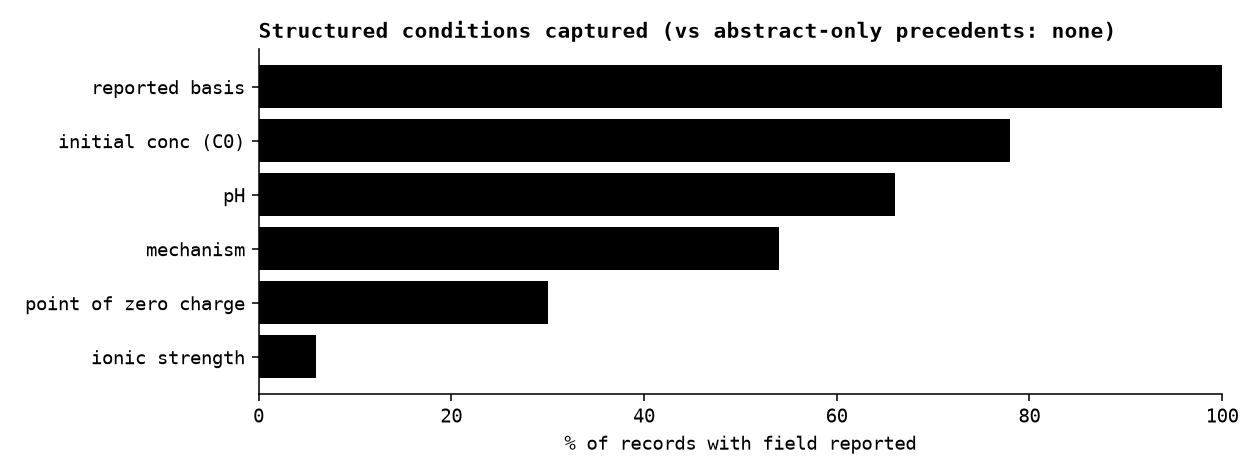
Three chemistry decisions, grounded in the field’s own methodological critiques (notably Tran et al., Water Research 2017): the fitted Langmuir Q_max (the legitimate cross-study comparator) is kept separate from an experimental q_e measured at one concentration (which is context-bound and not comparable); Freundlich constants are flagged as non-comparable because their units depend on the fit; and every value is normalized to mg/g, mmol/g, and meq/g using the reported chemical basis, so chromium reported as the element is never silently confused with chromate or dichromate.
[03] What it lets you do
Benchmark a contaminant, like for like
Pick a contaminant and compare materials on the one metric that is actually comparable, Langmuir Q_max on a molar basis. This is where units matter: in mg/g a heavy ion like lead looks strong simply because it is heavy, but on a molar basis copper outperforms it. The database does the conversion correctly and shows the spread honestly.
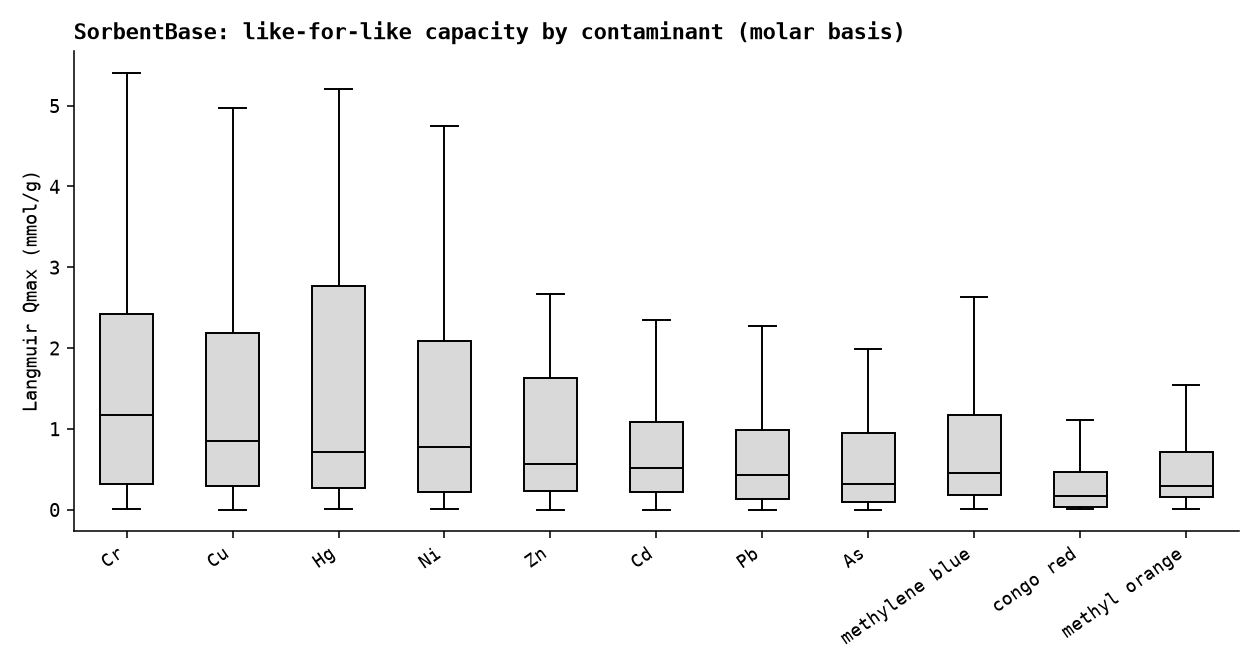
The chemistry it surfaces is the point a bulk descriptor like surface area misses. Capacity for heavy metals and oxyanions is set by binding chemistry, ion exchange, surface complexation, Lewis acid-base matching, not by raw surface area, and the database carries the mechanism and surface-charge fields to reason about that. It also exposes a real gap in the literature: only a small fraction of papers report competitive, multi-solute experiments, even though selectivity in real water is the true figure of merit for an engineered sorbent.
[04] Honesty
What to trust, and what not to
Extraction accuracy was validated against reference data: for hydroxyl-radical rate constants with an accepted compilation (Buxton et al. / NDRL), 12 of 13 benchmark compounds matched within a factor of about three. Still, automated extraction is imperfect, so plan for roughly 80 percent field-level precision and use the source link on every row to verify before you rely on a value.
Some limits are the literature’s, not ours. Langmuir Q_max is only a fair comparator when the isotherm approaches saturation and is fit nonlinearly, which the primary literature does not always do. Single-solute capacity overstates real multi-ion performance. And the field itself disagrees on parts of this, whether Q_max is a universal comparator at all, and which selectivity metric to benchmark on. We surface the data and the caveats rather than a verdict. A human-audited precision figure and a data-descriptor paper are in progress. The database and pipeline are open.